
In high-volume manufacturing plants, automotive service bays, and industrial assembly facilities, threaded fastening is the backbone of structural integrity. Selecting the correct air tool goes far beyond choosing a brand; it requires matching pneumatic motor dynamics, internal clutch mechanisms, and housing ergonomics to your specific production environment. A mismatch between tool capability and application can lead to premature tool failure, operator fatigue, or critical joint loosening under dynamic operational loads.
To build a reliable air tool fleet, engineering managers must first evaluate their plant-wide compressed air infrastructure alongside their catalog offerings. Reviewing a complete Pneumatic Impact Wrench Catalog provides a clear overview of available drive sizes, torque ranges, and clutch configurations required across different workstations.
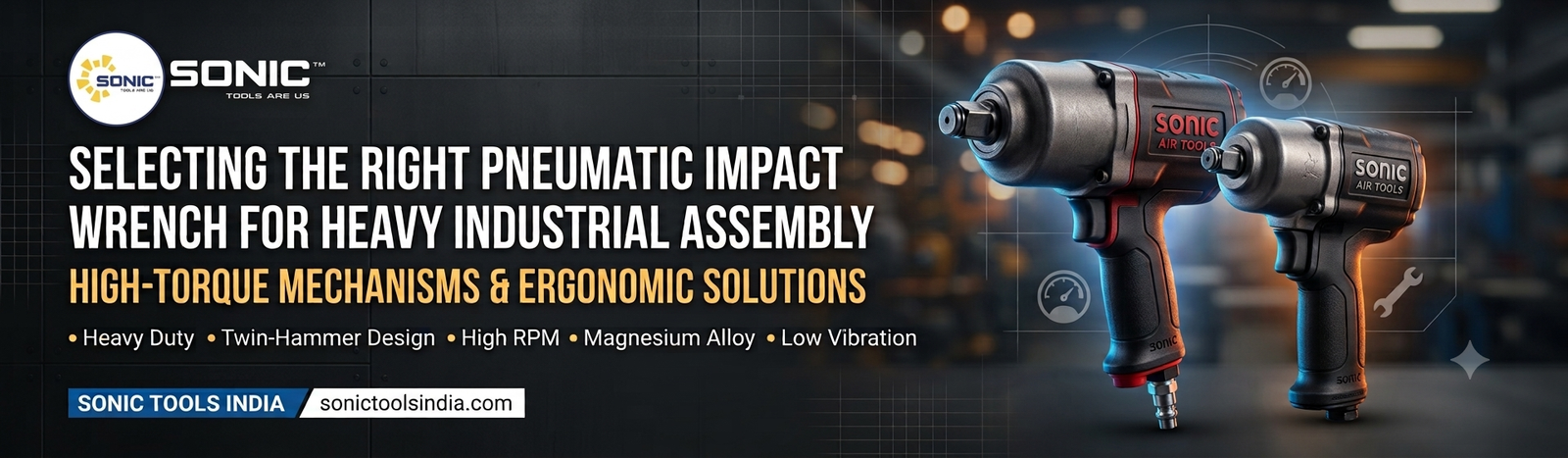
For standard garage maintenance, tire changing, and machinery overhaul, a versatile tool must handle varying torque requirements without incurring excessive wear. The industry benchmark for general service remains the 1/2-inch square drive tool equipped with a twin-hammer impact mechanism. Twin-hammer designs utilize two identical hammers that strike simultaneously on both sides of the anvil, providing balanced energy transfer and immediate breakout capability.
Recommended Fleet Tool: The Sonic 1/2" SD Air Impact Wrench delivers an optimal balance of structural rigidity, low vibration, and steady torque output. Its internal hammer cage is heat-treated to withstand continuous daily cycling in automotive repair shops and light industrial operations.
Continuous 8-hour or 24-hour plant operations demand a completely different class of pneumatic engineering. Standard commercial-grade tools subjected to uninterrupted production cycles frequently suffer performance degradation due to internal heat buildup, motor vane wear, and housing deflection. Industrial-grade impact wrenches feature reinforced rotor assemblies, hardened steel end plates, and heavy-duty anvils built to sustain high dynamic loads.
Recommended Industrial Tool: For demanding structural steel, flange bolting, and heavy equipment manufacturing, the Sonic Industrial Air Impact Wrench provides maximum breakaway torque and enhanced thermal tolerance. It ensures continuous duty cycle performance without loss of working RPM or internal mechanical binding.
Repetitive strain injuries (RSIs) and Hand-Arm Vibration Syndrome (HAVS) represent major operational risks in manufacturing. Traditional cast-iron or heavy aluminum tool bodies transfer significant vibration directly to the operator's hands while chilling during continuous air expansion. Upgrading tool housing materials directly mitigates these hazards.
Recommended Ergonomic Tool: Engineered explicitly to reduce worker fatigue, the Sonic Magnesium Alloy Case Air Impact Wrench utilizes advanced composite materials. The high-strength magnesium alloy casing significantly reduces overall weight while insulating the operator against cold exhaust air and dampening high-frequency mechanical feedback.
Cramped engine compartments, HVAC ducting, and internal machine frames present major clearance challenges. Standard pistol-grip impact wrenches are often too long or bulky to position square to the fastener face, forcing operators to use dangerous universal joints or hand ratchets that slow down production line tact times.
Recommended Stubby Tool: When working in spatial constraints under 6 inches of clearance, the Sonic 1/2" SD Stubby Jumbo Hammer Impact Wrench provides an ultra-short profile without sacrificing impact force. Its jumbo hammer mechanism uses a single heavy ring hammer to pack full-size torque into a body half the length of conventional models.
Not every industrial application requires hundreds of foot-pounds of brute torque. In light manufacturing, small engine repair, or cover-plate installation, applying excessive impact energy can strip threads, warp flanges, or snap smaller fasteners. Precision applications require smooth, controlled torque delivery with rapid motor acceleration.
Recommended Light-Duty Tool: For delicate assembly work, the Sonic 3/8" SD Rocking Dog Air Impact Wrench utilizes a rocking-dog clutch mechanism. This design delivers single-striking impact pulses that allow operators precise control over fastener seating without damaging sensitive components.
Even the highest-rated pneumatic impact wrench will underperform if supplied with inadequate compressed air. To ensure your tools achieve their published torque ratings, implement these three air-line engineering standards across your facility:
Maintain Dynamic Working Pressure: Always gauge pressure at the tool inlet while the trigger is fully depressed. Ensure dynamic pressure remains at 90 PSI (6.2 bar). Static pressure readings taken while the tool is idle are deceptive and hide line friction losses.
Eliminate Volumetric Air Restrictions: Pneumatic tools require high volume (CFM) as much as pressure (PSI). Use air supply hoses with a minimum internal diameter (ID) of 3/8" (1/2" ID for long runs over 25 feet) and swap out standard 1/4" NPT couplers for High-Flow (V-style) fittings.
Condition the Air Supply: Install dedicated Filter-Regulator-Lubricator (FRL) units within 10–15 feet of every workstation. Clean, moisture-free air mixed with continuous pneumatic oil mist prevents vane swelling, internal corrosion, and premature motor seizure.
 Get Dealer Price